

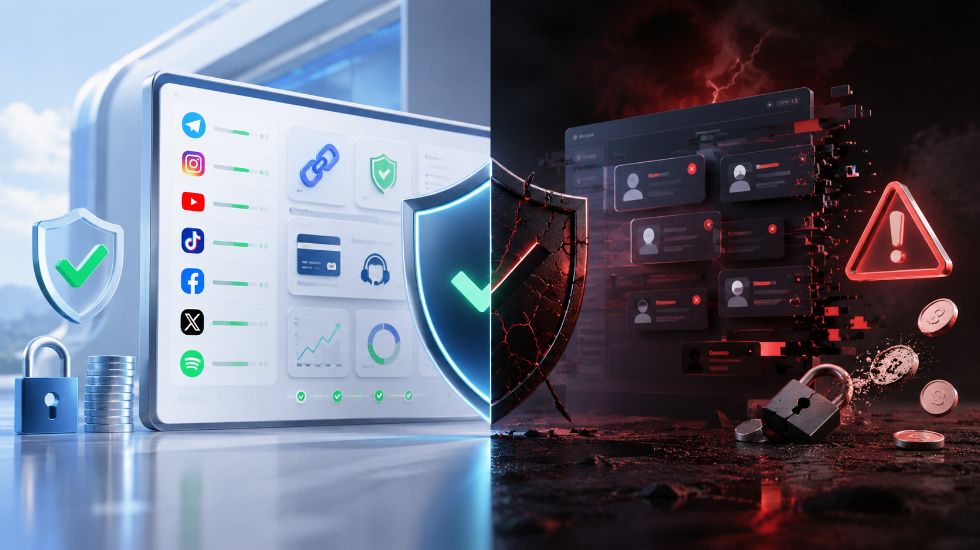
The question Is the SMM panel real or fake? usually appears before a user creates an account, adds balance, places a first order, or trusts a dashboard with social media services. It is a smart question because not every SMM panel works the same way. Some panels are real dashboard-based service platforms, some are low quality, and some may be fake or risky.
A real SMM Panel should not feel like a blind payment page. It should give users a working dashboard, visible service list, service descriptions, order history, transaction records, support tickets, public-link ordering, and clear rules for refill, no-refill, partial, cancelled, or failed orders.
This guide explains how to judge whether an SMM panel is real or fake before adding funds. You will learn what real panels usually look like, what fake panels often hide, why password requests are risky, how payment methods can reveal danger, how order tracking protects buyers, and why a small test order is safer than trusting a panel only because it looks professional. 🔎
Is the SMM panel real or fake?
Direct answer: An SMM panel can be real, fake, or low quality. A real SMM panel has a working dashboard, public-link ordering, service descriptions, order tracking, transaction history, support tickets, refill or no-refill rules, and realistic claims. A fake SMM panel may take deposits without delivery, hide service rules, avoid support, ask for passwords, pressure users into risky payments, or promise impossible results such as guaranteed sales, viral growth, permanent followers, or instant success.
Is the SMM panel real or fake? The answer depends on how the panel operates. A panel is not fake only because it sells social media services. The real question is whether it works transparently, explains service limits, tracks orders, protects user balance, and offers a clear support path when something goes wrong.
A professional-looking website can still be risky. Design alone is not proof. A safer buyer checks the inside of the system: whether the dashboard works, whether services have details, whether orders get IDs, whether transaction history is visible, whether support replies, and whether the panel avoids asking for sensitive account access.
| Panel Type | What It Usually Looks Like | Main Buyer Risk |
|---|---|---|
| Real SMM panel | Working dashboard, visible services, public-link ordering, tracking, support, and clear rules. | Normal service risks such as drops, delays, partial delivery, or no-refill limits. |
| Low-quality SMM panel | Dashboard may work, but service quality, support, descriptions, or delivery behavior may be weak. | Poor retention, unclear support, confusing service rules, and inconsistent delivery. |
| Fake SMM panel | May take deposits, hide rules, avoid support, ask for passwords, or never deliver. | Lost money, account-security risk, no delivery, and no recovery path. |
What Does a Real SMM Panel Look Like?
A real SMM panel usually has a user dashboard where customers can register, add funds, choose services, submit public links, place orders, track order statuses, review balance changes, and contact support. It should feel like an order-management system, not just a sales page with a deposit button.
A real panel should also explain what users are buying before payment. The user should know the required link type, minimum quantity, maximum quantity, start time, speed, refill rule, no-refill condition, and what may happen if the order becomes partial, cancelled, delayed, or failed.
If you are still learning the basic model, What is an SMM panel? explains how panels usually connect users, services, balance, orders, and dashboard tracking inside one system.
| Real Panel Signal | Why It Matters | What You Should Check |
|---|---|---|
| Working dashboard | Shows that the panel is more than a static homepage. | Login, service list, order form, balance, tickets, and order history should work. |
| Clear service list | Users know what they are buying. | Platform, category, service name, price, min/max, and service notes should be visible. |
| Service descriptions | Reduces wrong expectations and wrong-link orders. | Look for link format, speed, refill, restrictions, and delivery notes. |
| Order history | Creates a record after purchase. | Order ID, service, link, quantity, charge, date, and status should be available. |
| Order statuses | Helps users understand progress. | Pending, Processing, In Progress, Completed, Partial, Cancelled, or Failed should be clear. |
| Transaction history | Shows deposits, charges, refunds, and balance adjustments. | Balance should not change without a visible record. |
| Support tickets | Users need help when orders delay, drop, or fail. | Check whether support exists and whether responses are useful. |
| Public-link ordering | Safer than account-access requests. | Standard services should usually need public links, not passwords. |
Create Account
What Does a Fake SMM Panel Look Like?
A fake SMM panel may look normal at first. It may have a homepage, service names, cheap prices, and attractive promises. The problem usually appears after payment. Orders may stay stuck, support may stop answering, balance may not update correctly, or the dashboard may give no real tracking information.
Fake panels often hide operational details. They may not explain refill rules, drop risk, order status, refund conditions, wrong-link responsibility, or service limits. Some may also ask for passwords, two-factor codes, recovery email access, or session cookies, which is a serious warning sign for standard SMM services.
The biggest risk is that a user may not know the panel is fake until after funds are added. That is why a small test order, visible order records, public-link ordering, and support checks matter before trusting any panel with larger amounts.
| Fake Panel Signal | Why It Is Risky | Safer Reaction |
|---|---|---|
| No service descriptions | Users cannot understand what they are buying. | Avoid large orders until service details are clear. |
| No order tracking | No proof of processing, progress, or delivery. | Use panels that show order history and statuses. |
| No support response | Problems cannot be solved after payment. | Test support before adding a large balance. |
| Password requests | Creates account takeover risk. | Never share passwords, 2FA codes, or recovery access. |
| Unrealistic guarantees | Claims like guaranteed sales or viral growth are misleading. | Look for realistic limits and service notes. |
| No refund or refill rules | Buyer protection is unclear. | Check policy before ordering. |
| Fake-looking reviews | Trust may be fabricated. | Look for operational proof, not badges only. |
| Pressure to deposit quickly | Urgency can stop users from checking details. | Slow down and verify the panel first. |
Real SMM Panel vs Fake SMM Panel
The difference between a real SMM panel and a fake SMM panel is not only appearance. The real difference is whether the panel can process orders, track delivery, explain service rules, manage balance records, handle support, and respond when an order has a problem.
A fake panel may use cheap pricing, premium design, or urgency to attract deposits. But when the user needs accountability, the panel usually fails. If there is no clear order status, no ticket system, no transaction history, no service explanation, and no refill or refund logic, the buyer has very little protection.
To understand what a working panel flow should look like, read How do SMM panels work?. It explains how service selection, target links, order quantities, balance deduction, and order statuses fit together inside a normal panel workflow.
| Feature | Real SMM Panel | Fake SMM Panel |
|---|---|---|
| Dashboard | Works and lets users place, view, and track orders. | May be broken, decorative, or unclear after deposit. |
| Service details | Shows descriptions, min/max, speed, and refill rules. | Uses vague claims with little operational detail. |
| Ordering method | Uses public links for standard services. | May ask for passwords, login codes, or private access. |
| Support | Ticket or contact system is available. | No reply, delayed reply, or fake support behavior. |
| Status tracking | Shows order progress clearly. | No clear order updates after payment. |
| Payment records | Transaction history is visible. | Deposits and balance changes may be unclear. |
| Claims | Uses realistic limits and service notes. | Promises guaranteed sales, viral results, or permanent growth. |
| User risk | Managed through rules, records, and support. | High uncertainty and weak accountability. |
Why Some People Think All SMM Panels Are Fake
Some people think all SMM panels are fake because they have experienced drops, failed orders, poor support, fake-looking engagement, or scam websites. These problems are real, but they do not prove that every SMM panel is fake. They show why buyers need to evaluate each panel carefully.
Sometimes the problem is an actual fake panel. Sometimes it is a low-quality service. Sometimes the user ordered a no-refill service and expected replacement. Sometimes the wrong link was submitted. Sometimes the buyer expected guaranteed sales from a service that only supports visibility.
This is also why SMM should be understood as one part of a wider marketing strategy, not a magic button. The guide Is SMM better than seo? explains how SMM and SEO solve different growth problems and why social visibility should not replace long-term content strategy.
| Reason Users Lose Trust | What May Actually Be Happening | Better Interpretation |
|---|---|---|
| Cheap services dropped | The service may be low-retention or no-refill. | Check refill rules before ordering. |
| No-refill order lost quantity | The service may not include replacement. | No-refill should be understood before buying. |
| Wrong link submitted | The order may fail or deliver incorrectly. | Use the exact required public link. |
| Fake panel took payment | The site may be a scam or abandoned dashboard. | Test small before adding large funds. |
| Unrealistic promises failed | The claim may have been misleading from the start. | Avoid guaranteed sales or viral-growth promises. |
| No support response | The panel may be weak or fake. | Test support before trusting the platform. |
| Low-quality engagement | The service source may be poor. | Compare service descriptions and test different rows. |
Start Small Test
How Real SMM Panels Usually Work
A real SMM panel works like an order-management system. The user creates an account, adds balance, chooses a service, submits the correct public target link, enters quantity, confirms the charge, receives an Order ID, and follows the order status inside the dashboard.
Behind the scenes, the panel may use provider routes, backend automation, or internal workflows to process orders. The user does not need to see every technical step, but the dashboard should show enough information to explain what is happening.
Real panels also have limits. Orders may stay Pending before they start. Some services may become Partial. Some may have no refill. Some may take longer than expected. A trustworthy panel explains these situations instead of hiding them.
| Step | What Happens | Why It Matters |
|---|---|---|
| User creates account | Dashboard access begins. | The user can manage balance, orders, and support. |
| User adds funds | Balance is credited after payment confirmation. | Transaction history should show the deposit. |
| User chooses service | Service details and price are reviewed. | The user should understand rules before ordering. |
| User submits link | Public target is provided. | Correct links reduce failed or wrong-target orders. |
| User enters quantity | Charge is calculated. | The buyer sees cost before submission. |
| Order is placed | Order ID is created. | Support can review the order later. |
| Status updates | Progress appears in the dashboard. | Users can track Pending, Processing, Completed, or Partial states. |
| Support handles issues | Tickets help with delays, drops, or payment problems. | A real panel should offer a way to ask for help. |
Warning Signs of a Fake SMM Panel
Warning signs of a fake SMM panel include missing service rules, no support system, no order tracking, password requests, unrealistic guarantees, hidden refund rules, broken dashboard pages, fake-looking review badges, and pressure to deposit quickly. One red flag alone may not prove a scam, but several together should make the buyer careful.
Payment behavior also matters. If a seller pushes only hard-to-recover payment methods and provides no transparent policy, no support, and no order tracking, the user should slow down. The FTC warns that scammers often prefer payment methods that are difficult to trace or recover, including gift cards, wire transfers, payment apps, and cryptocurrency.
A trustworthy panel should not rely on pressure. It should let users read service details, test small, contact support, and review transaction history before making larger decisions.
| Warning Sign | Why It Matters | Risk Level |
|---|---|---|
| No service rules | Buyer cannot judge refill, speed, limits, or risk. | High |
| Password request | Creates account-security risk. | Very high |
| No ticket support | No clear help path after payment. | High |
| No order history | No tracking proof after ordering. | High |
| Guaranteed sales or viral growth | Unrealistic claim. | High |
| No refund or refill information | Buyer protection is unclear. | Medium to high |
| Broken dashboard | System reliability is weak. | Medium to high |
| Only unusual payments | Recovery may be difficult if the seller disappears. | High |
| Pressure to deposit quickly | Urgency can be used to stop users from checking details. | High |
Should an SMM Panel Ask for Your Password?
For standard SMM services, an SMM panel should usually not ask for your password. Basic services such as followers, likes, views, members, comments, reactions, post views, video views, or page likes should normally work through public links, usernames, profile links, post links, channel links, video links, or track links.
If a panel asks for your password, two-factor authentication code, recovery email access, session cookies, admin access, or private account login for basic services, treat that as a serious warning sign. Sharing login access can lead to account takeover, changed passwords, stolen pages, removed admins, or suspicious activity from your account.
There may be rare services on the internet that require account access for very specific management tasks, but those are not normal public-link SMM panel orders. For ordinary SMM services, safer panels should use target links, not account credentials.
| Never Share | Why It Is Dangerous | Safer Alternative |
|---|---|---|
| Password | Can lead to account takeover. | Use public links for standard services. |
| 2FA code | Can bypass account security. | Never provide login verification codes. |
| Recovery email access | Can lead to full account loss. | Keep recovery details private. |
| Session cookies | Can allow login without a password. | Never paste browser session data anywhere. |
| Admin access | Can allow unauthorized control of pages or channels. | Use limited, official roles only when truly necessary. |
| Payment details in chat | Can expose financial information. | Use secure payment pages and official records. |
| API keys or tokens | Can allow account or system abuse. | Keep API keys private and rotate if exposed. |
Try Public-Link Ordering
How to Check an SMM Panel Before Adding Funds
Before adding funds to an SMM panel, check the dashboard first. Does the site load properly? Are services visible? Do services include descriptions? Is there an order page? Is there a support area? Is there a transaction history section? Does the panel explain refill, no-refill, partial, cancel, or failed-order behavior?
Do not start with a large deposit. A small test order gives real evidence. It shows whether the panel accepts the order, tracks status, updates delivery, handles remains, and responds if something goes wrong. If the first small test feels confusing or unsupported, a large deposit is not wise.
It is also smart to compare value before buying. The guide Are SMM panels worth the cost? explains why service value depends on goals, service quality, refill rules, retention, and realistic expectations.
| Pre-Deposit Check | Why It Matters | Good Sign |
|---|---|---|
| Service descriptions | Explains what is delivered and what limits exist. | Each service includes notes, rules, or clear expectations. |
| Support response | Shows whether help exists after payment. | Support replies clearly and does not avoid basic questions. |
| Order tracking | Confirms that dashboard function exists. | Orders show ID, link, quantity, status, and charge. |
| Public-link ordering | Reduces account-access risk. | Standard services ask for links, not passwords. |
| Refill rules | Explains whether dropped quantity can be replaced. | Refill or no-refill status is stated before order. |
| Refund or cancel policy | Clarifies failure handling. | Panel explains what happens with cancelled or partial orders. |
| Test order option | Reduces first-order risk. | Minimum order is low enough to test safely. |
| Transaction history | Tracks balance changes. | Deposits, charges, and refunds appear in records. |
| Realistic wording | Avoids false expectations. | No guaranteed sales, viral reach, or permanent results forever. |
Why Order Tracking Matters
Order tracking matters because users need to know what happened after payment. A real SMM panel should show enough order information to help the user and support team understand the order. Without tracking, the user is left guessing whether the order started, failed, completed, or became partial.
Good order tracking usually includes Order ID, service name, target link, quantity, charge, date, status, start count, remains, and sometimes provider-related progress. This information is important if the user later opens a support ticket.
A panel without tracking feels risky because there is no clear record. If the user pays and the dashboard gives no status, no history, and no support reference, it becomes difficult to prove what was ordered or what went wrong.
| Order Tracking Field | Purpose | Why It Helps Support |
|---|---|---|
| Order ID | Unique order reference. | Support can find the exact order quickly. |
| Service name | Shows selected service. | Support can check service-specific rules. |
| Target link | Shows where the order was sent. | Helps detect wrong-link problems. |
| Quantity | Shows ordered amount. | Support can compare delivered and remaining quantity. |
| Charge | Shows cost deducted from balance. | Helps review refunds or partial returns. |
| Start count | Shows the starting metric before delivery. | Helps measure whether delivery happened. |
| Remains | Shows undelivered amount. | Helps identify partial orders. |
| Status | Shows order condition. | Explains whether the order is Pending, Processing, Completed, Partial, or Cancelled. |
| Date | Shows order time. | Helps check start-time and refill windows. |
Why Service Descriptions Matter
Service descriptions matter because they explain what the user is actually buying. A good description should include required link type, minimum order, maximum order, start time, speed, refill or no-refill rule, restrictions, and notes about platform-specific behavior.
If a service only says “best quality” or “instant delivery” without details, the user cannot judge risk. Vague descriptions create wrong expectations, wrong-link orders, support tickets, and refund disputes. A trustworthy panel gives users enough information before they pay.
Service descriptions also help beginners understand that SMM services are not all equal. A no-refill service, a refill-supported service, a targeted service, a fast service, and a premium service may have different rules. Clear descriptions reduce confusion.
| Good Description Includes | Why It Helps | Problem If Missing |
|---|---|---|
| Required link type | Prevents wrong-link orders. | User may submit profile link instead of post link. |
| Minimum order | Prevents quantity errors. | User may enter invalid quantity. |
| Maximum order | Prevents oversized orders. | Order may fail or become delayed. |
| Start time | Sets waiting expectation. | User may think a normal delay is a scam. |
| Speed | Sets delivery expectation. | User may expect instant completion. |
| Refill or no-refill | Explains drop coverage. | User may expect replacement that is not included. |
| Restrictions | Prevents failed delivery. | Private, deleted, or restricted targets may not work. |
| Platform-specific notes | Explains special rules. | User may misunderstand how the service works. |
Compare Services
How Payment Methods Can Reveal Risk
Payment methods can reveal risk because some payment types are harder to reverse than others. A panel that accepts only hard-to-recover methods and gives no support, no tracking, no policy, and no service transparency should be treated carefully.
Cryptocurrency payments are not automatically fake. Many online businesses use crypto. But crypto can be harder to recover if the seller disappears. Gift card payment requests are especially risky in online scams. The FTC warns that scammers often push payment methods that are difficult to trace or recover, including gift cards, wire transfers, payment apps, and cryptocurrency.
A safer buyer does not judge payment method alone. The real question is whether the payment method is combined with transparency. If the panel has clear transaction history, order tracking, support, service rules, and a small test option, risk is lower than a site that only says “deposit now” and gives no proof of operation.
| Payment Situation | Risk Level | Buyer Note |
|---|---|---|
| Card or protected payment with records | Lower risk | Still check service rules and order tracking. |
| Protected payment method where available | Lower to medium risk | Keep receipts and transaction IDs. |
| Crypto with known trusted panel | Medium risk | Use small tests before larger deposits. |
| Crypto-only unknown panel | Higher risk | Be careful if support and tracking are weak. |
| Gift card request | Very high risk | Major scam warning sign. |
| Wire transfer to unknown seller | High risk | Recovery may be difficult. |
| No transaction history | Higher risk | User cannot easily track deposits or charges. |
Are Cheap SMM Panels Always Fake?
Cheap SMM panels are not always fake. Some panels offer low-cost services because they use lower-cost provider sources, general services, no-refill rows, high-supply view services, or basic delivery routes. A cheap service can be real, but it may have limitations.
The problem is when cheap pricing is combined with no descriptions, no support, no tracking, no refill rules, and huge promises. A very cheap service that clearly says no refill and explains the limits is different from a fake panel that promises permanent followers, instant viral reach, and guaranteed sales.
Price is only one signal. A buyer should compare price with service notes, refill, delivery speed, support, test order behavior, and order tracking. Cheap does not always mean fake, but cheap plus hidden rules is risky.
| Cheap Panel Signal | What It May Mean | Trust Interpretation |
|---|---|---|
| Clear descriptions | The panel explains service limits. | Better trust signal. |
| No-refill clearly stated | The service may be lower cost but less protected. | Honest limitation if stated before ordering. |
| Small test order works | The dashboard can process at least small orders. | Good operational sign. |
| Support responds | The user has a help path. | Better sign. |
| Huge impossible promises | The seller may be misleading users. | Red flag. |
| No tracking | User cannot verify order progress. | Red flag. |
| No refill or refund rules | Buyer protection is unclear. | Red flag. |
Are Expensive SMM Panels Always Real?
Expensive SMM panels are not automatically real or high quality. A higher price may reflect better source quality, refill support, targeting, slower delivery, stronger retention, or better support. But it can also be used by fake sellers to make a service look premium.
A buyer should evaluate expensive panels the same way they evaluate cheap panels. Does the dashboard work? Are services explained? Does support respond? Are refill rules clear? Is there order tracking? Can the buyer start with a small order? Does the panel avoid impossible guarantees?
The safest conclusion is simple: cheap does not always mean fake, and expensive does not always mean real. Trust should come from transparent operation, not price alone.
| Higher Price May Reflect | But It Does Not Guarantee | What to Check |
|---|---|---|
| Better source | Real customers or loyal followers. | Service description and test order behavior. |
| Refill support | Zero drops forever. | Refill period and rules. |
| Targeting | Perfect audience fit. | Country, language, or niche details. |
| Slower delivery | Perfect safety or permanent results. | Speed notes and limits. |
| Premium branding | Real service quality. | Operational proof, not only design. |
| Better support | Guaranteed results. | Ticket response and policy clarity. |
Test Panel Quality
What to Do If an SMM Panel Scams You
If you think an SMM panel scammed you, collect evidence first. Save payment receipts, Order IDs, screenshots, support messages, service descriptions, dashboard records, transaction history, and any promises made before payment. Evidence matters because it may help with payment disputes or reports.
Then contact the payment provider quickly. The FTC advises people who sent money to a scammer to contact the company behind the payment method and ask whether the transaction can be reversed. Recovery depends on the payment method, timing, and provider rules, but waiting usually reduces options.
If you shared passwords or login details, change the password immediately, enable two-factor authentication, remove unknown sessions, check connected apps, and review recent account activity. If financial information was exposed, contact your bank or payment provider as soon as possible.
| Situation | Action | Why It Matters |
|---|---|---|
| Paid by card | Contact card issuer quickly. | Chargeback or dispute may be possible. |
| Paid through payment app | Report through the payment app. | Ask whether reversal or investigation is possible. |
| Paid with crypto | Document everything. | Recovery may be difficult, but records still matter. |
| Shared password | Change password immediately. | Prevents further unauthorized access. |
| Shared 2FA or session data | Revoke sessions and secure the account. | Stops possible login bypass. |
| Panel disappeared | Save screenshots, receipts, URLs, and messages. | Evidence helps reports and disputes. |
| Order never delivered | Open a dispute if possible. | Payment provider may request proof. |
| Fake support asks for more money | Stop paying. | Scammers often ask for repeated payments. |
Safe Checklist Before Using an SMM Panel
Before using an SMM panel, go through a simple safety checklist. The goal is not to remove every possible risk, because all online services have some level of risk. The goal is to avoid obvious fake panels, weak services, unclear rules, and unsafe account behavior.
A good checklist helps beginners slow down before payment. If the panel fails several basic checks, do not deposit a large balance. If the panel passes the checks, still start small and observe real behavior before scaling.
| Checklist Item | Why It Matters | Safe Action |
|---|---|---|
| Dashboard works | Shows the platform is operational. | Check services, order page, balance, and history. |
| Service descriptions exist | Explains what you are buying. | Read notes before ordering. |
| Public-link ordering | Reduces account-security risk. | Use links, not passwords, for standard services. |
| No password requests | Protects account access. | Never share login codes or recovery details. |
| Refill and cancel rules | Explains what happens after drops or failed orders. | Choose services with rules you understand. |
| Support responds | Shows there is a help path. | Ask a basic question before a large deposit. |
| Small test order possible | Reduces first-order risk. | Test before scaling. |
| Order tracking exists | Shows delivery status. | Review Order ID and status after ordering. |
| No unrealistic promises | Protects against misleading claims. | Avoid guaranteed sales, viral growth, or permanent-result claims. |
| Records are saved | Helps if there is a dispute. | Keep receipts, screenshots, and Order IDs. |
Common Mistakes When Judging SMM Panels
A common mistake is judging an SMM panel only by design. A fake site can look professional, and a real site can look simple. What matters more is whether the dashboard, service descriptions, order tracking, transaction records, and support system actually work.
Another mistake is adding a large balance before testing. A small test order gives real evidence about delivery speed, order status, support response, and service quality. If a small order goes badly, the user avoids losing more money.
A third mistake is believing guaranteed claims. No SMM panel can honestly guarantee real customers, loyal followers, sales, ranking, monetization, or viral success. Panels can support visible signals, but real growth still depends on content, offer, audience, trust, and platform behavior.
| Mistake | Why It Is Wrong | Better Approach |
|---|---|---|
| Trusting design only | Fake sites can look professional. | Check function, support, tracking, and records. |
| Choosing only the cheapest panel | Cheap can hide weak services. | Test small and read service rules. |
| Assuming expensive means real | Price can be used as a mask. | Verify operations before trusting premium claims. |
| Ignoring service rules | Creates wrong expectations. | Read descriptions, refill, speed, and restrictions. |
| Sharing passwords | Creates account-security risk. | Use public links for standard services. |
| Adding large balance first | Bigger loss if the panel is fake. | Start with a small deposit and small order. |
| Believing guaranteed claims | Guaranteed sales or viral growth is unrealistic. | Look for clear limits and honest wording. |
| Ignoring payment risk | Some payment methods are harder to recover. | Use safer methods where possible and keep records. |
| Not saving proof | Harder to dispute or report issues. | Save receipts, screenshots, messages, and Order IDs. |
| Calling all panels fake | Ignores working panels and different quality levels. | Judge case by case using trust signals. |
Create Free Account
What Should You Realistically Expect?
You should realistically expect that some SMM panels are real, some are low quality, and some are fake. The goal is to identify trust signals before spending money. A real panel should offer transparent service rules, public-link ordering, order tracking, transaction history, support tickets, refill or no-refill rules, and realistic claims.
You should not expect any SMM panel to guarantee real customers, loyal followers, viral reach, sales, ranking, monetization, or permanent results forever. Even real panels can have drops, delays, partial orders, cancelled orders, no-refill services, or provider-side issues. A trustworthy panel explains these limits instead of hiding them.
Is the SMM panel real or fake? The answer depends on transparency and behavior. If the panel has working systems, public-link ordering, service details, order tracking, support, and realistic rules, it is more trustworthy. If it hides everything, asks for passwords, pressures deposits, and promises impossible outcomes, treat it as risky. 💡
| Truth Framing | What It Means for Buyers |
|---|---|
| SMM panels exist as real service dashboards. | The model itself is real, but quality varies. |
| Fake SMM panels also exist. | Some sites are built to take deposits or steal access. |
| A real panel should have order tracking and support. | Users need records and help after ordering. |
| A fake panel often hides rules. | No descriptions, no status, and no policy create risk. |
| Password requests are serious red flags. | Standard services should usually use public links. |
| Cheap does not always mean fake. | Cheap services may be real but lower quality or no-refill. |
| Expensive does not always mean real. | Price alone does not prove trust. |
| Start with a small test order. | Testing reduces first-order risk. |
| Avoid unrealistic claims. | No panel should promise guaranteed sales or viral growth. |
| Judge panels by transparency, not design alone. | Operations matter more than appearance. |
Final Thoughts on Real and Fake SMM Panels
SMM panels can be real, fake, or simply low quality. A real panel should behave like a transparent service dashboard: clear service list, public-link ordering, balance records, order tracking, support tickets, refill rules, and realistic expectations. A fake panel often hides rules, avoids accountability, pressures users to deposit, asks for sensitive access, or disappears after payment.
The best way to protect yourself is to slow down before adding funds. Read service descriptions, test support, avoid password sharing, review payment safety, place a small test order, save records, and do not believe impossible promises. A panel that is real and professional should make the buying process understandable, not mysterious.
Trust in SMM panels should be earned through operation. Design, low prices, or big promises are not enough. Working systems, clear rules, and support response are what separate a more reliable panel from a risky one.
FAQ About Real and Fake SMM Panels
These FAQs answer common questions about whether SMM panels are real or fake, how to check trust signals, what warning signs matter, whether password requests are safe, and how cheap pricing should be understood before ordering.
Is the SMM panel real or fake?
An SMM panel can be real or fake. Real SMM panels have working dashboards, service descriptions, order tracking, support tickets, transaction history, and clear service rules. They usually let users place orders through public links and track progress inside the account.
Fake SMM panels may take deposits without delivery, hide service details, ask for passwords, show fake-looking reviews, avoid support, or make unrealistic promises such as guaranteed sales, viral growth, or permanent followers.
How can I know if an SMM panel is real?
You can check if an SMM panel is real by testing the dashboard, reading service descriptions, checking support response, reviewing refill and refund rules, looking for order tracking, and placing a small test order before adding a large balance.
A real panel should explain what it can and cannot do. If the site hides service rules, offers no support, and gives no way to track orders, it is much harder to trust.
What are signs of a fake SMM panel?
Signs of a fake SMM panel include no service descriptions, no order tracking, no support response, password requests, fake-looking reviews, broken pages, hidden refund rules, and unrealistic guarantees such as guaranteed sales, viral growth, or permanent followers.
Payment pressure through hard-to-recover methods can also be a warning sign, especially if the panel gives no clear transaction history, no policy, and no support path after payment.
Should I trust an SMM panel that asks for my password?
No. For standard SMM services, you should not trust a panel that asks for your password, login code, two-factor authentication code, recovery email access, or session cookies. Basic services should usually work through public links, usernames, post links, video links, channel links, or profile links.
Password requests are a serious security warning because they can lead to account takeover, changed credentials, lost admin access, or suspicious activity from your account.
Are cheap SMM panels fake?
Cheap SMM panels are not always fake. Some cheap services are real but lower quality, no-refill, faster, or higher-risk. Low price can happen because the service source is cheaper, broader, or more limited.
However, very cheap pricing with no descriptions, no support, no tracking, and unrealistic promises can be a red flag. Always test small before placing larger orders.
Are expensive SMM panels always real?
No. Expensive SMM panels are not automatically real or trustworthy. A higher price may reflect better retention, targeting, refill support, or provider quality, but price alone does not prove that a panel is safe.
The better approach is to check dashboard function, service descriptions, order tracking, support response, refill rules, transaction history, and small-order performance before trusting a panel with a larger balance.
What should I do if an SMM panel scams me?
If you think an SMM panel scammed you, save evidence first. Keep payment receipts, Order IDs, screenshots, support messages, dashboard records, service descriptions, and transaction history. Then contact your payment provider quickly and ask whether a dispute or reversal is possible.
If you shared passwords or login details, change the password immediately, enable two-factor authentication, remove unknown sessions, and check account activity. If financial information was exposed, contact your bank or payment provider.