

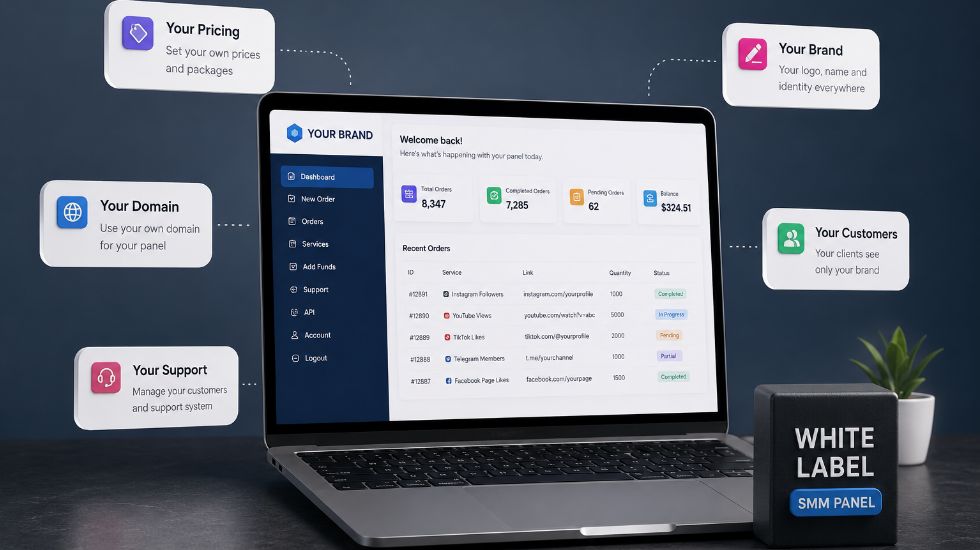
When people start exploring SMM panel business models, they often see terms like white label, child panel, reseller panel, custom panel, and provider API. These terms can sound similar, but they do not mean the same thing. If you already understand how an Instagram Smm Panel works, the next step is understanding how someone can sell SMM services under their own brand without building the full system from zero.
The question What Is White Label in an SMM Panel? is important for resellers, agencies, freelancers, and startup owners who want to launch a branded SMM panel faster. White label can help you use your own domain, logo, pricing, and customer-facing identity while relying on an existing backend system.
This guide explains what white label means, how it works behind the scenes, how it differs from reseller panels, child panels, and custom panels, and what you should check before choosing a white label setup. ✅
What Is White Label in an SMM Panel?
Direct answer: White label in an SMM panel means using a ready-made SMM panel system under your own brand name, logo, domain, pricing, and customer-facing identity. The backend service, software, or provider may belong to another company, but your customers see the panel as your branded platform. White label helps you start faster without building the full technology and provider system from scratch, but you still need to manage pricing, support, service quality, policies, and customer trust.
In simple terms, What Is White Label in an SMM Panel? means you can launch a branded SMM service website without developing every technical part yourself. You may customize the visible side of the panel while the backend software, service source, or provider connection runs behind the scenes.
If you are still learning the base structure, What is an SMM panel? explains how users place orders, add balance, choose services, and track delivery before moving into reseller or white label business models.
Create Free Account
How Does a White Label SMM Panel Work?
A white label SMM panel works by separating the customer-facing brand from the backend system. The panel owner controls the visible brand, pricing, service names, and customer experience, while the backend software or provider system handles order processing and service delivery.
When a customer places an order, the panel may send the order to a provider through API or through the parent system. The customer usually does not see the original provider. They interact with the branded panel and expect support, pricing, and service rules from that brand.
| Step | What Happens |
|---|---|
| User gets white label access | Provider or platform gives branded panel setup. |
| User adds branding | Logo, name, colors, domain, and content may be customized. |
| Services are connected | Services may come from provider, API, or backend panel. |
| Customer places order | Customer orders from the branded panel. |
| Order is processed | Backend provider or API handles delivery. |
| Panel owner manages users | Pricing, support, balance, and policies are handled by the owner. |
| Customer sees your brand | Backend source is usually hidden from end users. |
White Label SMM Panel vs Reseller Panel
A reseller panel usually means buying services from another panel and reselling them to customers, sometimes without a fully branded dashboard. A white label SMM panel gives more branding control because the service can appear under your own domain, logo, and business name.
The main difference is customer perception. With white label, users may feel they are ordering from your own platform. With basic reselling, the business may depend more visibly on another provider or parent panel.
If you want to understand the reseller model separately, What Is SMM Reseller Panel? explains how reselling works, why markup matters, and what beginners should know before selling services to clients.
| Factor | White Label Panel | Reseller Panel |
|---|---|---|
| Branding | Stronger brand control. | Usually limited branding. |
| Domain | Often custom domain. | May use provider dashboard. |
| Customer Experience | More independent. | More dependent on parent panel. |
| Setup Speed | Fast. | Fast. |
| Control | Medium. | Lower. |
| Backend Ownership | Usually not owned. | Not owned. |
| Best For | Agencies, brands, semi-serious resellers. | Beginners testing resale. |
| Main Risk | Quality depends on backend/provider. | Quality and branding control are limited. |
White Label SMM Panel vs Child Panel
A child panel is usually a sub-panel created under a parent SMM panel. It allows a reseller to run a separate branded or semi-branded panel while still depending on the parent system for services, balance, and backend functions.
White label is a broader branding concept. A child panel can be a type of white label setup if it allows custom branding and domain use. However, not every child panel gives the same level of white label control.
For a more focused explanation, What Is a Child Panel in SMM Panel? explains how child panels work under a parent system and why backend dependency matters.
| Factor | White Label SMM Panel | Child Panel |
|---|---|---|
| Meaning | Branded panel under your identity. | Sub-panel created under a parent panel. |
| Branding | Usually logo/domain customization. | Often limited customization. |
| Backend | Usually parent/provider system. | Parent panel system. |
| Control | Depends on provider. | Usually limited. |
| Setup | Quick. | Quick. |
| Best For | Agencies and branded resellers. | Beginners and small resellers. |
| Main Limitation | Backend dependency. | Parent panel dependency. |
Start Testing Services
White Label SMM Panel vs Custom SMM Panel
A white label SMM panel is faster to launch because the software and backend system already exist. A custom SMM panel gives more control, but it usually requires more development, hosting, API setup, security work, payment integration, and maintenance.
Beginners and agencies often start with white label because it reduces technical work. A custom panel may be better later when the business has enough customers, stable providers, and clear operational needs.
| Factor | White Label Panel | Custom SMM Panel |
|---|---|---|
| Setup Time | Faster. | Slower. |
| Cost | Lower or medium. | Higher. |
| Branding | Good. | Full control. |
| Backend Control | Limited. | Full or advanced. |
| Development Needed | Usually low. | High. |
| Provider Flexibility | Depends on system. | More flexible. |
| Maintenance | Mostly handled by provider/platform. | Owner must manage. |
| Best For | Faster branded launch. | Serious long-term operators. |
What Can You Brand in a White Label SMM Panel?
A white label SMM panel may allow you to customize your logo, panel name, domain, colors, service pricing, support identity, homepage content, and legal pages. The exact level of customization depends on the provider or software system.
Branding is important because users judge trust quickly. A white label panel should not look like a copied empty dashboard. It should include clear service descriptions, support rules, privacy policy, refund policy, and realistic delivery explanations.
| Branding Element | Common Availability |
|---|---|
| Logo | Usually available. |
| Domain name | Often available. |
| Panel name | Usually available. |
| Colors/theme | Sometimes available. |
| Homepage text | Depends on system. |
| Service names | Sometimes editable. |
| Pricing | Usually controllable. |
| Support identity | Usually under your brand. |
| Email notifications | Sometimes customizable. |
| Payment methods | Depends on setup. |
| Legal pages | Should be customized. |
Who Should Use a White Label SMM Panel?
A white label SMM panel is useful for agencies, resellers, freelancers, local marketers, and new panel owners who want to launch a branded service website without building the full backend from scratch.
It is especially useful when the user already has an audience, client base, or marketing channel. White label setup can provide the dashboard, but the business still needs traffic, trust, support, and service quality control.
| User Type | Why White Label May Help |
|---|---|
| Agencies | Offer branded services to clients. |
| Resellers | Start selling under their own name. |
| Freelancers | Add SMM services to existing offers. |
| Local marketers | Serve small business clients. |
| Panel startups | Test the market before custom build. |
| Influencer service brands | Sell social visibility services. |
| Niche service websites | Offer platform-specific packages. |
What Are the Benefits of White Label SMM Panels?
The main benefit of a white label SMM panel is speed. You can launch a branded SMM service website without building the software, provider system, and order infrastructure from scratch.
White label also gives better brand control than basic reselling. You may be able to use your own domain, logo, pricing, and customer support identity while still relying on an existing backend system for order processing.
| Benefit | Why It Matters |
|---|---|
| Faster launch | No need to build everything from zero. |
| Brand control | Customers see your name. |
| Lower technical work | Backend may already be managed. |
| Reseller-friendly | Useful for agencies and service sellers. |
| Pricing control | You can add markup. |
| One dashboard | Manage users and orders in one place. |
| Scalable starting point | Good for testing demand. |
| Lower entry barrier | Easier than custom development. |
Create Your Account
What Are the Limitations of White Label SMM Panels?
A white label SMM panel is not the same as full ownership. The backend system, provider connection, service availability, and some technical features may still depend on the company powering the panel.
This means the panel owner must be realistic. If the backend provider has delays, service drops, API issues, or price changes, the white label panel may be affected. White label saves setup time, but it does not remove operational responsibility.
| Limitation | Explanation |
|---|---|
| Backend dependency | You depend on provider or parent system. |
| Limited customization | Not all features can be edited. |
| Service quality varies | Backend providers control delivery. |
| API limits | Some systems restrict integrations. |
| Payment limits | Gateways may depend on setup. |
| Support responsibility | Customers expect you to help. |
| No full ownership | You may not own the core software. |
| Similar layouts | Other resellers may use similar panels. |
How Pricing and Profit Work in White Label SMM Panels
White label SMM panel profit usually comes from markup. The backend provider may give a base service cost, and the panel owner sets a higher selling price for customers. The difference becomes potential profit.
However, real profit is not only the markup. Payment fees, support time, refunds, failed orders, partial orders, and customer complaints can reduce margin. A smart white label owner should price services with enough room for support and risk.
| Pricing Element | Meaning |
|---|---|
| Provider cost | Base cost from backend/source. |
| Selling price | Price shown to your customers. |
| Markup | Difference between cost and selling price. |
| Payment fee | Gateway or transaction cost. |
| Support cost | Time spent handling issues. |
| Refund buffer | Balance reserved for failed or partial orders. |
| Real profit | Markup after all costs and problems. |
How Providers and API Work Behind White Label Panels
A white label SMM panel often depends on backend providers or API connections. When a customer places an order, the branded panel may send the service ID, link, quantity, and order details to a provider system for processing.
This is why provider quality matters. Even if the white label panel looks professional, delivery speed, refill support, order status, and service stability may depend on the provider behind the system.
For a better understanding of backend workflow, How do SMM panels work? explains how order routing, providers, API behavior, balance, and status tracking connect inside a panel.
White Label, Script, and Starting Your Own Panel
White label is not the only way to launch an SMM panel. Some users may consider scripts, custom development, API integrations, or provider-based setups. A script usually gives more technical control than a simple reseller dashboard, but it also creates more responsibility for hosting, security, updates, payments, and maintenance.
If you are comparing software options, What Is an SMM Panel Script? explains how scripts differ from ready-made reseller or white label options.
Users who want a broader roadmap can also read How to Create Your Own SMM Panel? before deciding whether white label, child panel, reseller panel, or custom development is the better fit.
What Should You Check Before Choosing a White Label Panel?
Before choosing a white label SMM panel, check both the branding options and the backend quality. A good white label setup should help you build a trusted customer-facing panel, not just a copied dashboard with unclear services.
- Check whether custom domain is supported.
- Review logo and branding options.
- Test service quality with small orders.
- Check provider/API stability.
- Review service categories and platform coverage.
- Compare refill and no-refill rules.
- Check payment method options.
- Ask how support and disputes are handled.
- Review pricing control and markup options.
- Check whether legal pages can be customized.
- Ask what happens if the parent provider changes prices.
- Confirm whether you can export data if you leave later.
If you are planning a full launch rather than a small test, How to Start a SMM Panel? can help you think through setup, services, pricing, customer support, and early marketing decisions.
Test Services First
Common Mistakes With White Label SMM Panels
A common mistake is thinking that white label means full ownership of the entire system. In reality, many white label panels still depend on a parent platform, provider, or backend API. If that source changes pricing, removes services, or has delivery problems, the white label panel may be affected.
Another mistake is launching the panel without customizing the brand, support pages, service descriptions, and policies. A white label panel should not look like an empty copied dashboard. It needs trust signals, clear explanations, and realistic service rules.
| Mistake | Why It Is a Problem | Better Approach |
|---|---|---|
| Thinking white label means full ownership | Backend may still be controlled by provider. | Understand dependency. |
| Choosing only by low setup price | Service quality may be weak. | Test backend first. |
| Not customizing content | Panel looks generic. | Add real brand pages. |
| Ignoring support workflow | Customers will contact you. | Prepare support process. |
| No refund/refill policy | Disputes become messy. | Write clear rules. |
| Adding too many services | Hard to control quality. | Start with tested services. |
| Overpromising results | Damages trust. | Use realistic claims. |
| Not checking payment fees | Profit margin drops. | Calculate full cost. |
| Depending on one provider | Service outage risk. | Ask about backup options. |
| No SEO strategy | Panel gets no traffic. | Build content and service pages. |
What Should You Realistically Expect?
A white label SMM panel can help you launch faster and sell services under your own brand. It can reduce development work and give agencies or resellers a quicker way to enter the market.
However, it does not guarantee customers, profit, or perfect delivery. You still need to manage marketing, pricing, support, service quality, legal pages, customer trust, and realistic expectations. White label is a shortcut for setup, not a shortcut for building a reliable business.
- It can help you launch faster.
- It can support your own brand.
- It can reduce technical setup.
- It does not mean full backend ownership.
- It does not guarantee profit.
- It still requires testing, support, and marketing.
For broader digital marketing context, HubSpot’s Social Media Marketing Guide is a useful external resource because it shows why tools, services, and panels still need a real strategy, audience understanding, and consistent execution.
Join NiceSMMPanel
Final Thoughts on White Label in SMM Panels
What Is White Label in an SMM Panel? It means using a ready-made SMM panel system under your own brand name, domain, logo, pricing, and customer-facing identity. It can help resellers and agencies launch faster without building the full software and provider network from scratch.
The safest way to approach white label is to treat it as a business setup model, not a guaranteed shortcut. You still need to test service quality, set realistic prices, create clear policies, manage support, build trust, and avoid overpromising results. 💡
Create Account Now
FAQ About White Label SMM Panels
These FAQs answer the most common questions users ask when they compare white label SMM panels, child panels, reseller panels, custom panels, and branded SMM service websites.
What is white label in an SMM panel?
White label in an SMM panel means using a ready-made panel system under your own brand name, domain, logo, and pricing. Your customers see your brand, while the backend software or provider system may be powered by another company. It helps resellers and agencies launch faster without building the full technology from scratch.
Is a white label SMM panel the same as a reseller panel?
Not exactly. A reseller panel usually means selling services from another provider, often with limited branding. A white label SMM panel gives stronger brand control, such as custom domain, logo, panel name, and customer-facing identity. However, both models may still depend on a parent provider or backend system.
Is a white label SMM panel the same as a child panel?
A child panel can be a type of white label setup if it allows custom branding and domain use. However, not every child panel offers full white label control. The exact difference depends on the provider, customization options, backend access, and pricing model.
Can I make money with a white label SMM panel?
Yes, a white label SMM panel can make money if you attract customers, set profitable pricing, manage support well, and use reliable services. Profit usually comes from the difference between provider cost and your selling price. However, profit is not guaranteed. Marketing, service quality, payment fees, refunds, support time, and customer retention all affect real earnings.
What should I check before buying a white label SMM panel?
Check custom domain support, branding options, provider quality, service list, API stability, payment methods, pricing control, refill rules, support process, legal page customization, and what happens if services or prices change. You should also test small orders before selling services to real customers.